Kelly Dockery
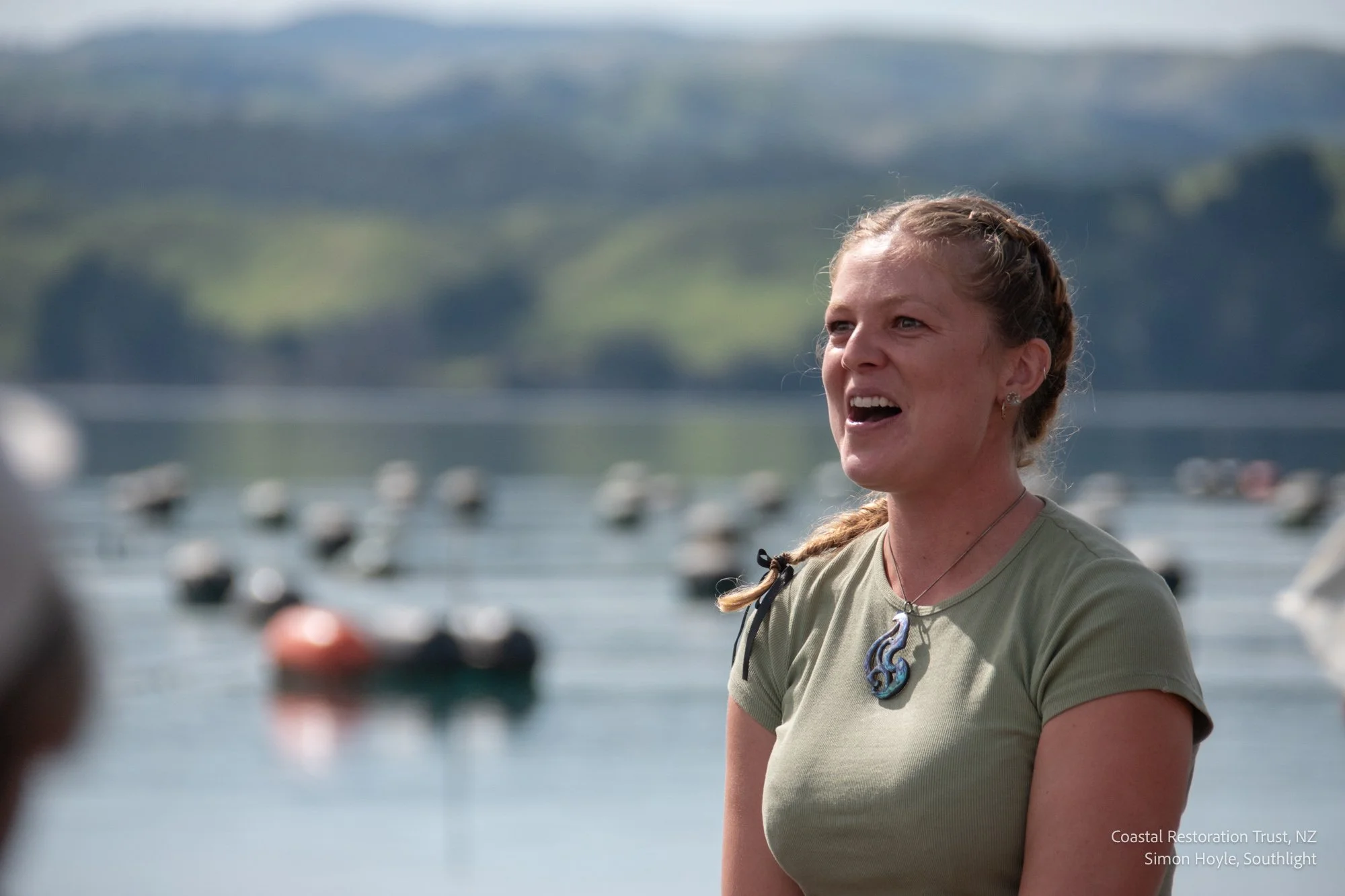
“No matter what your interest is, if you’re prepared to give it a go there are so many options,” she says. “Whether it’s driving boats, diving, or working with macroalgae, there are heaps of ways to enter the industry.”
Sustainability Officer (and sometimes deckhand) Bachelor of Science in Ecology and Biodiversity (University of Waikato) Bachelor of Sport and Recreation (AUT)
No matter where she was living—overseas or in the big city—Kelly Dockery always knew she would be involved in her family’s mussel spat-catching business.
Aotea Marine Farms in Kāwhia is owned by Kelly’s parents, Ross and Janine Dockery, and by the time the couple’s three daughters—Kelly, Georgia and Eilish—were teenagers, they were already helping out on the boats.
“Coming from a small town, I went to boarding school in Hamilton, then studied at AUT in Auckland, and later worked overseas,” says Kelly. “But I always came home during the holidays to help out.”
The farm deploys hundreds of thousands of kilometres worth of mussel rope every year to capture the rich supply of mussel larvae flowing into the harbour.
“We have a couple of catches each year and, as long as we time it right, we get a high level of spat,” she says. “It’s really small—under 10 millimetres—and most of it you can’t even see with the naked eye.”
After three or four months, the ropes are lifted and transported in sacks to supply mussel farms in the Coromandel.
“We’re able to offer an alternative source of spat to Ninety Mile Beach, which helps maintain supply, especially as demand is always high,” says Kelly.
The farm is run as a family operation, with each member naturally falling into their own role.
“My dad is the practical one—he drives the trucks and looks after the hands-on work. Mum manages the finances, my sister works on the boats, and I take care of compliance and re-consenting paperwork.”
For Kelly, that diversity of roles is what makes aquaculture such an attractive industry.
“No matter what your interest is, if you’re prepared to give it a go there are so many options,” she says. “Whether it’s driving boats, diving, or working with macroalgae, there are heaps of ways to enter the industry.
“If you have a hope and a dream, and you’re willing to work hard and give it a go, aquaculture is a great industry to get into—no matter which entry point you choose.”