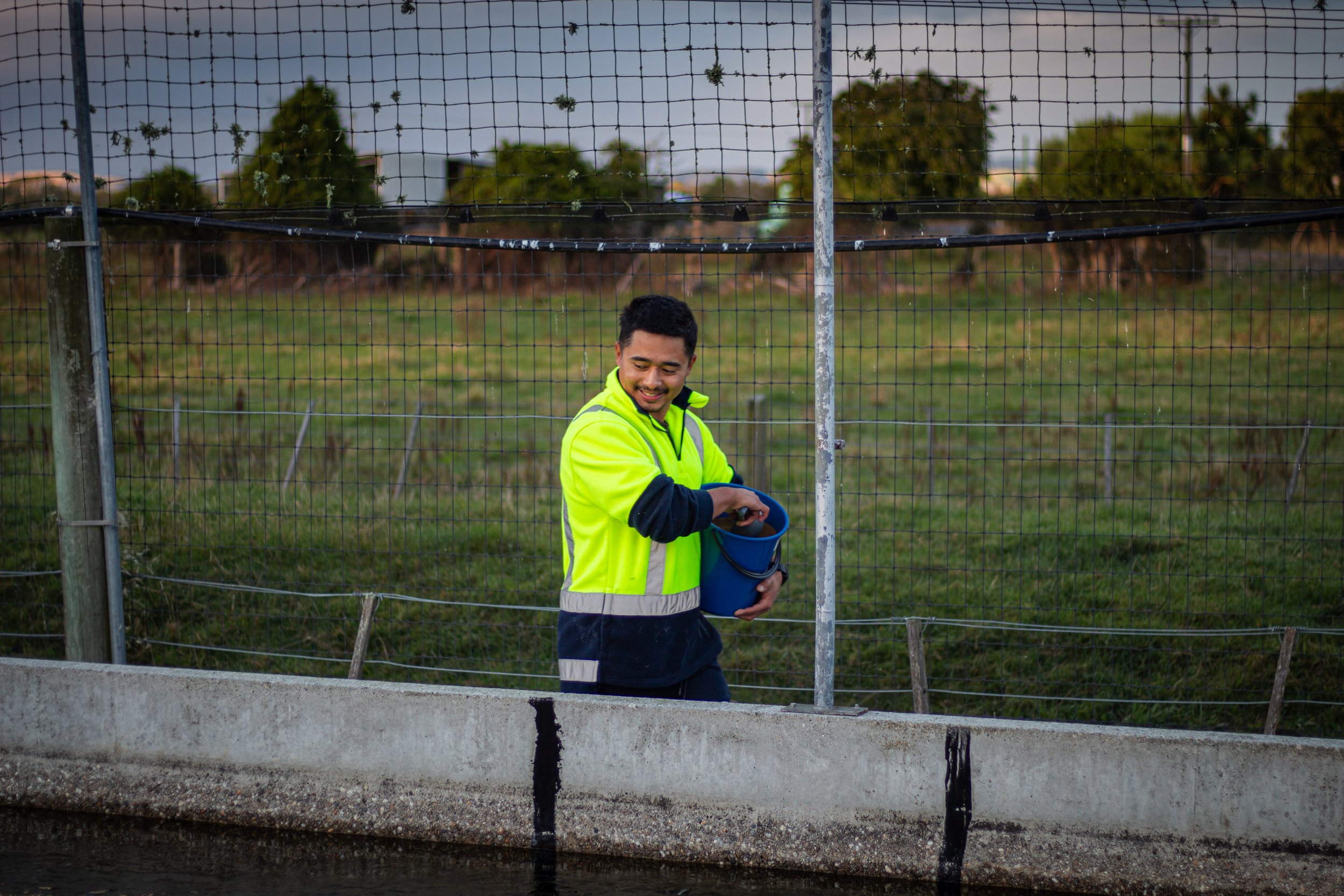
“If you care about the environment and want to make an impact on sustainability, aquaculture is worth exploring. You don’t need a degree. Passion and drive matter more.”
Technical Lead - Feeding and Logistics - Akaroa King Salmon
For Hiroki Wada, aquaculture has been part of life for as long as he can remember. Growing up in Nepal, he spent much of his childhood alongside his father, who worked in trout breeding and aquaculture development.
“Dad was involved in the breeding of rainbow trout and different projects. I was always going in and out of the field with him, and there were lots of fisheries books around the house,” Hiroki says. “From there I knew I wanted to do something in the aquaculture space.”
After high school, Hiroki decided to follow that passion overseas. While many of his classmates planned to study in Australia, New Zealand also appealed to him.
“All I knew about New Zealand was the kiwi bird,” he jokes.
At 17 he moved to Nelson to begin the Diploma in Aquaculture at NMIT. Although English was part of his schooling in Nepal, settling into a new culture and academic environment came with challenges.
“I struggled with English at first,” he says, “but the two year programme gave me a great start.”
In his second year he picked up weekend work at the Cawthron Aquaculture Park.
“That was really good exposure for me—different species, different research projects. It opened up my understanding of what aquaculture could be.”
After completing his diploma in 2018, he went straight into a bachelor’s degree, continuing part time work with Cawthron before joining the team full time. He spent almost two years in finfish research and discovered a clear preference for that part of the industry.
“I realised I prefer the finfish industry. Mussels are a bit boring for me—they just stand still,” he laughs. “Salmon are more interactive. You can see straight away how feeding affects them, and their health is more visual.”
He enjoyed learning about RAS systems, feeding trials, and the engineering behind land based salmon production. After completing his degree in 2020, he became an aquaculture technician focused on finfish research.
In 2022 he joined Skretting Australia to trial different diets, based in Okiwi Bay on a 7 days on, 7 days off roster. This gave him time to continue studying full-time and finish his Postgraduate Diploma in Sustainable Aquaculture.
After nearly two years, he decided he wanted more experience on the commercial farming side and set his sights on hatcheries. That led him to Sanford’s salmon hatchery in Kaitangata, near Balclutha producing smolt for Big Glory Bay. Now he is Technical Lead - Feeding and Logistics at Akaroa King Salmon
Hiroki is also part of a mentorship programme, which he says has been transformative. “Being new in a role, you have lots of ideas and want to share them, but sometimes you don’t fully see the manager’s perspective. Mentorship has helped me build more empathy, understand what works, and read people better.” He adds, “I built up more confidence and learned more about the business before stepping up.”
Longer term, Hiroki hopes to return to Nepal: “In the back of my mind, I know I want to go back and contribute to aquaculture there.”
For now, he has settled in Rolleston after recently buying his first home.
His advice for anyone considering a career in aquaculture is simple: “If you care about the environment and want to make an impact on sustainability, aquaculture is worth exploring. You don’t need a degree. Passion and drive matter more.”