Spotting problems and solving them with interesting technology is Adam Hutchinson’s superpower.
He says he starts by noticing what’s missing and then sets out to fill the gap.
Over the years, this approach has led Adam to develop various solutions including the New Zealand fishing rules app, created after realising people couldn’t access regulations easily. The same thinking led to CamperMate, developed when freedom camping began growing faster than the information supporting it.
This same mindset has now taken Adam underwater.
While diving around Banks Peninsula, Adam became interested in how difficult it is to understand real-time water conditions.
“Being able to forecast dive visibility underwater was the original idea — so people could see what conditions will be like,” he says.
The challenge, he quickly realised, was that water conditions are influenced by many variables.
“For instance, around Banks Peninsula there are lots of factors you need data on to make a prediction. It’s challenging.”
This led to a simple question: why don’t we place a buoy in the ocean to detect visibility or turbidity in real time?
In early 2025 Adam contacted Bruce Hearn, a veteran Marlborough Sounds mussel farmer, and he discovered a problem for aquaculture is the lack of timely information about what’s happening in the water, particularly with algal blooms.
“With manual water testing, there’s a big gap between doing nothing and the weekly sample farmers send away,” Adam says. “What we’re trying to do is plug that gap.”
Adam pulled together a small team and began experimenting with what could be done using a buoy stationed offshore.
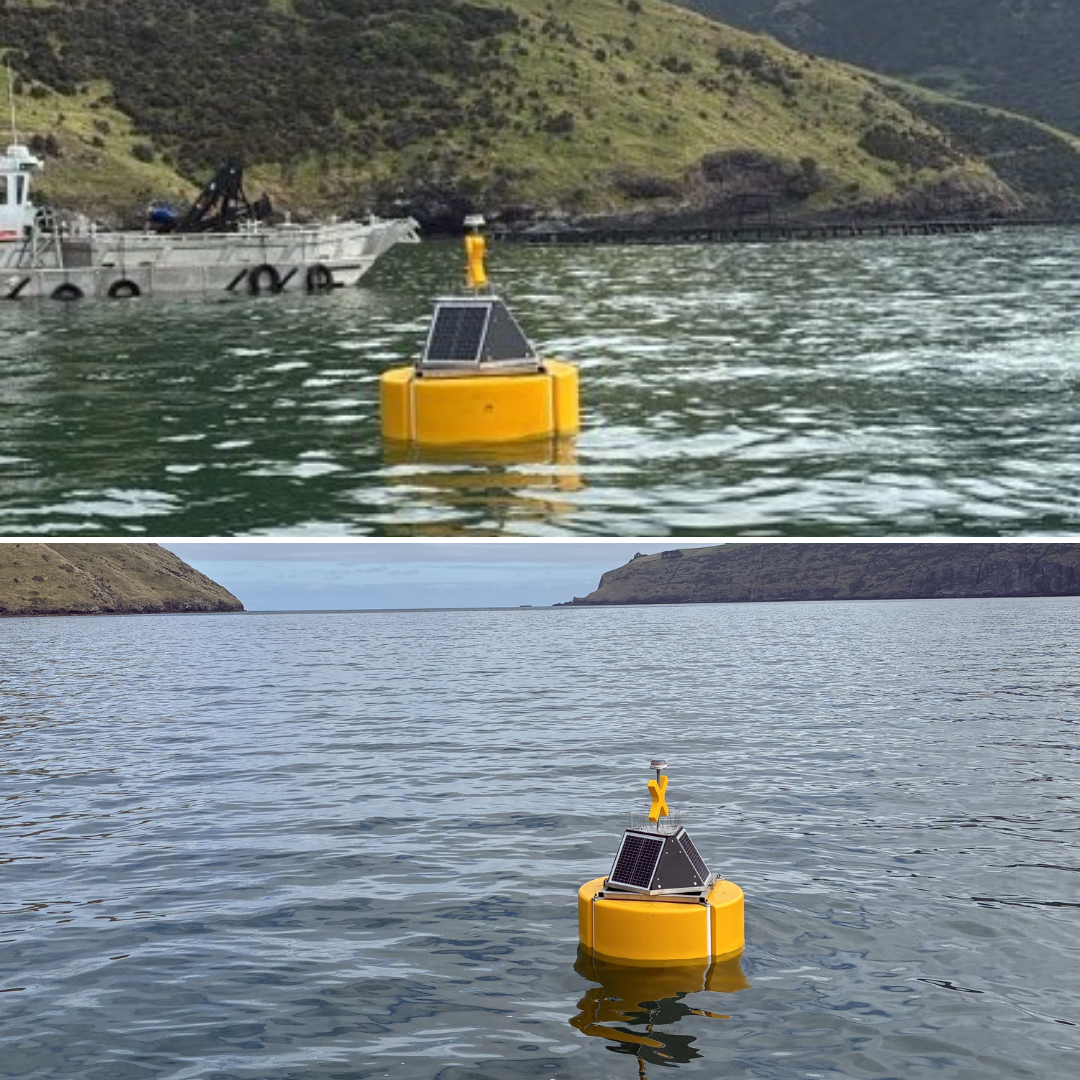
The solution was both simple and ambitious: draw small samples of water into the buoy, take thousands of images, send them to a server, and build and train algorithms to analyse what’s in the water — particularly plankton species.
“The system is aiming to work alongside lab testing like Cawthron,” Adam says, “and work as an early warning system if data is indicating levels of a particular species are getting higher.”
Working closely with Cawthron, MPI, and industry partners, Adam’s team has mapped species of concern and begun real-world deployment.
One buoy is currently in the water — at Wainui for Akaroa Salmon, another is planned in Port Levy for Aroma, and a third in the Marlborough Sounds with MSQP.
Designing the hardware for coastal conditions hasn’t been easy.
“The ocean is challenging,” Adam says. “We’ve had people involved who have real experience deploying buoys, and that knowledge has been critical.”
Each buoy can capture around 20,000 images a day.
The first buoy was only deployed in March 2026 but is already transmitting thousands of images.
“The focus now is developing and training the algorithm so it can scan images at scale and tell you what’s going on in the water in near real time.”
Adam says the project is self-funded and still very much a startup.
“It’s born out of a garage at this point,” Adam laughs. “We go as fast as capital allows, but three buoys is a good number for where we’re at.”
Ultimately, the value lies in the data.
“The true benefit comes from turning that data into meaningful insights for the aquaculture industry,” Adam says. “Long term, we want low-cost hardware, lots of data, well trained scalable algorithms that can run across potentially millions of images ultimately providing better information for mussel and salmon farmers.”
As the 24-month pilot continues, the goal is clear: improve the information available to the industry and help fill a knowledge gap that’s existed for years.
“When companies are keen to actively work with you, that’s a really good sign,” Adam says. “If this works well, it will be a huge benefit for the industry.”
“The true benefit comes from turning data into meaningful insights for the aquaculture industry.”